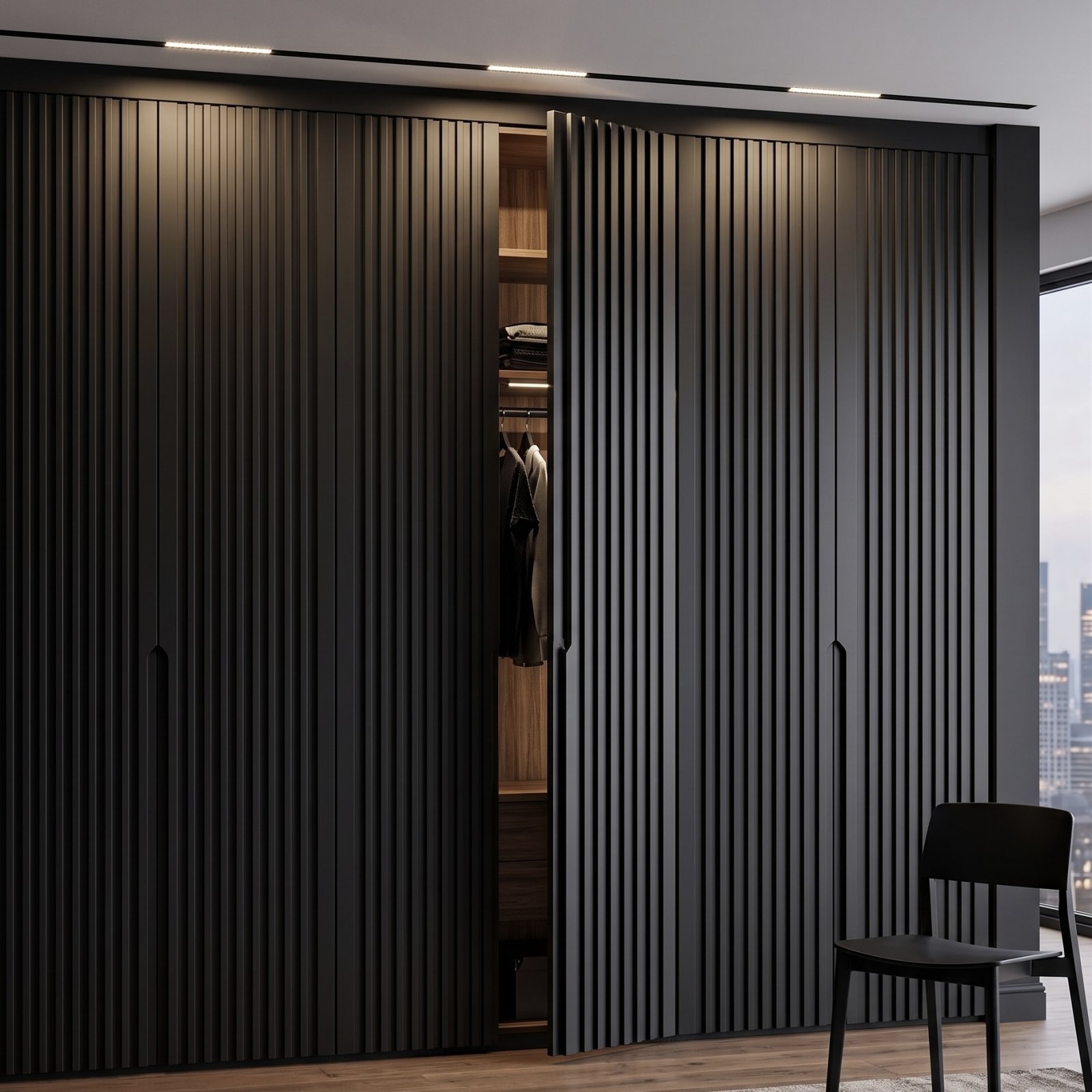
A reclaimed timber wardrobe may seem like the obvious sustainable choice, but no single material tells the whole story. Choosing eco friendly wardrobe materials uk shoppers find on the market takes more than comparing labels: sourcing, surface finishes, manufacturing and expected lifespan all matter. Broad claims can make products difficult to compare, so it helps to know what evidence to look for.
This guide sets out practical checks for timber sourcing, finishes and end-of-life options, and explains why reclaimed, engineered and solid wood involve different considerations. Assess the whole wardrobe, including how it is made and how long it may remain useful. A bespoke specification can also be shaped around your space and requirements, whether you are considering a complete wardrobe or replacement doors.
Key Takeaways
- Compare reclaimed timber, responsibly sourced solid wood and engineered boards as different options, rather than assuming one is always better.
- Assess eco friendly wardrobe materials uk by identifying the material, tracing its source and checking what any certification or sustainability claim actually covers.
- Consider the finish, expected lifespan and end-of-life options alongside the material when assessing a wardrobe’s environmental impact.
- Set priorities for your project before choosing a specification. Bespoke or made-to-measure design offers flexibility, but does not by itself establish a lower impact.
Eco-friendly wardrobe materials in the UK: what should you compare?
Choosing between eco friendly wardrobe materials uk suppliers offer means weighing evidence about origin, processing and finish, as well as how long a wardrobe may remain useful and what could happen to it at the end of its life. The principles and materials of sustainable furniture design provide useful context, but each product should be assessed on its own details.
Reclaimed wood, solid timber and engineered boards: the distinctions
Reclaimed wood is timber reused from an earlier purpose. Its previous use may be part of its appeal, but provenance and condition still matter. Find out what is known about its origin and consider whether its condition suits the intended wardrobe design. The word “reclaimed” alone does not explain its history, treatment or remaining service life.
Responsibly sourced solid wood raises different questions. Consider the species, source and evidence behind any sourcing claim. Engineered boards also need to be judged using product-specific information, rather than assumed to be either better or worse than solid timber. Check the board description and surface finish, then consider whether these suit the wardrobe’s intended use and expected lifespan.
Material choice alone cannot establish a wardrobe’s total impact. Sourcing, processing, finish, useful lifespan and end-of-life options all contribute. For a practical comparison, record what is known about each factor and what remains unclear. This makes trade-offs visible without treating a label as proof. A carefully specified wardrobe, including replacement doors where appropriate, can be assessed against the needs of the project without assuming bespoke design itself reduces environmental impact.
How to assess wardrobe material claims, finishes and durability
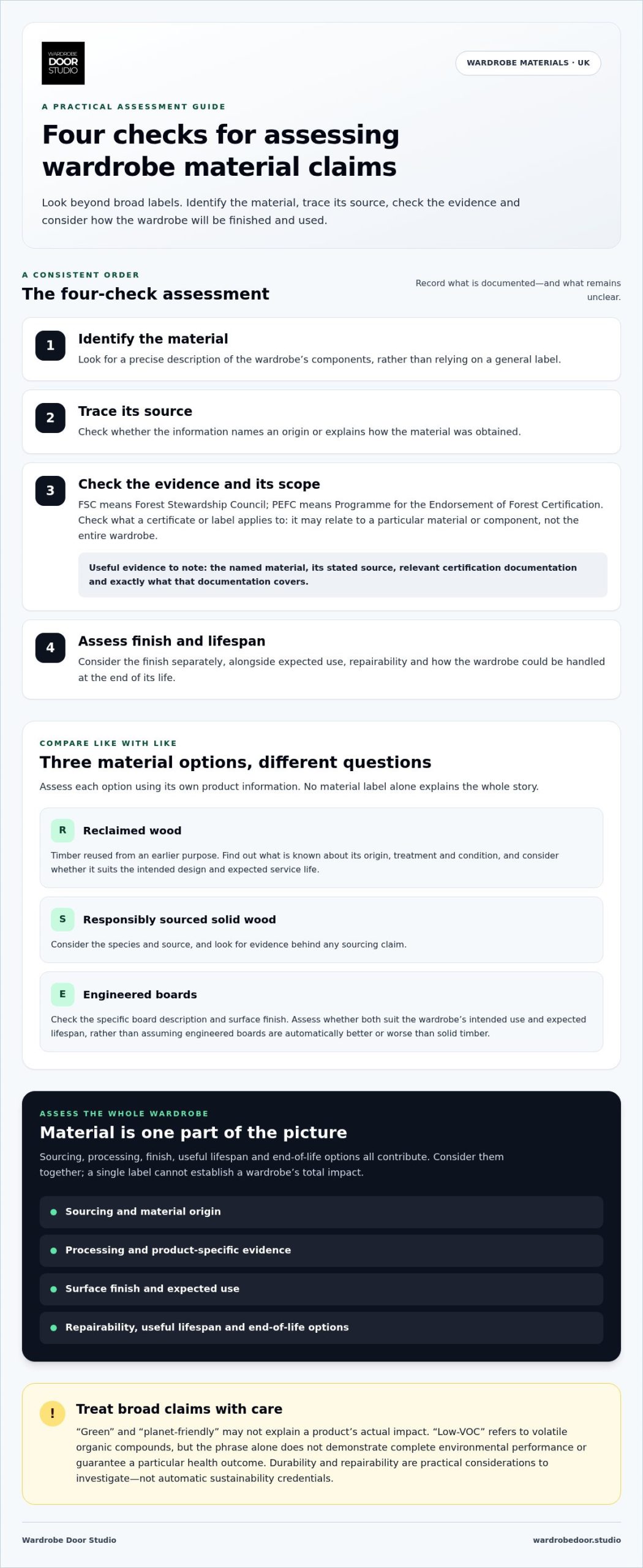
Assess eco friendly wardrobe materials uk claims in a consistent order. Separate documented details about the material from broad phrases such as “green” or “planet-friendly”, which may not explain a product’s actual impact.
- Identify the material. Look for a precise description of the wardrobe’s components, not just a general label.
- Trace its source. Check whether the information names an origin or explains how the material was obtained.
- Check the evidence. FSC stands for Forest Stewardship Council; PEFC stands for Programme for the Endorsement of Forest Certification. These certification names can help you assess sourcing claims. Check what a certificate or label applies to, such as a particular material or component, rather than assuming it covers the entire wardrobe.
- Assess finish and lifespan. Consider the finish separately, along with expected use, repairability and how the wardrobe could be handled at the end of its life.
What evidence can support a more informed material choice?
For a sourcing claim, look for a material description, information about its source and relevant certification documentation. A finish described as low-VOC refers to volatile organic compounds, but that phrase alone does not demonstrate a product’s complete environmental performance or guarantee a particular health outcome. Treat durability and repairability as practical considerations to investigate, not automatic sustainability credentials.
Checklist: record the named material, its stated source, the evidence and its scope, the finish, and information about expected use before weighing broad marketing language. This makes gaps easier to spot and comparisons more precise.
For a design-led project tailored to exact specifications, explore Wardrobe Door Studio’s Bespoke Solutions. A tailored design can help define the wardrobe you need, but is not, by itself, evidence of lower environmental impact.
Choosing a wardrobe specification that reflects your priorities
Turn your research into a clear project brief. Decide which factors matter most for your wardrobe, such as documented sourcing, a suitable finish, expected period of use, or realistic options for repair and end of life. Then compare each specification against those priorities. If documented timber sourcing is essential, make it a requirement rather than treating an unrelated claim about appearance or customisation as evidence.
Be realistic about what a specification can prove. Bespoke or made-to-measure design allows dimensions and details to be tailored to the space, but it does not automatically demonstrate a lower environmental impact. Use the same evidence-based approach whether you are planning a complete fitted wardrobe or considering a change to existing doors.
When replacement doors or a bespoke wardrobe may fit the brief
Project scope can range from Replacement wardrobe doors to made-to-measure fitted wardrobes. Replacing doors is a distinct project choice, not proof by itself of a particular environmental benefit. For help weighing that option, see the replacement wardrobe door guide. Finishes deserve separate consideration too. The wardrobe finishing guide explores that part of the specification.
Wardrobe Door Studio creates bespoke wardrobes manufactured in England to exact specifications. Supply & Fit and Supply Only describe ways to arrange the project, not environmental credentials. Assess the materials and evidence for the chosen specification separately. Explore Bespoke Solutions to define a design around your space while keeping environmental claims grounded in the product information available.
Shape your next wardrobe decision with confidence
Set out what matters for your space, then use that brief to compare suitable specifications without relying on a single sustainability label. A considered approach to eco friendly wardrobe materials uk is about making choices you can explain and feel confident living with, rather than looking for a claim that promises a perfect answer.
Wardrobe Door Studio creates bespoke wardrobes manufactured in England. Choose Supply & Fit or Supply Only to suit how you want the project delivered. These options describe the service route, not the environmental performance of the materials.
Explore bespoke wardrobe solutions and take the next step towards a wardrobe shaped around your home and priorities.
Frequently Asked Questions
Is reclaimed wood always the most eco-friendly wardrobe material?
No. Reclaimed wood is not automatically the most eco-conscious option for every wardrobe. Its previous use may offer a reuse benefit, but a damaged or poorly documented piece may suit a different project from an intact, traceable one. Consider whether the timber can meet the intended dimensions and finish without extensive adaptation. Assess the specific material, not just its reclaimed label.
Can MDF or other engineered boards be an eco-friendly choice for wardrobes?
An engineered board may be a considered choice, but the material name alone does not establish its environmental profile. When comparing eco friendly wardrobe materials uk options, review information about the specific board and wardrobe component, such as a door or internal panel. Compare like with like, including stated sourcing, production details, finish and intended use, rather than assuming all boards share the same characteristics.
What do FSC and PEFC certification mean when choosing wardrobe materials?
FSC and PEFC are forestry certification schemes, but a logo or general statement does not necessarily describe every part of a finished wardrobe. Read the accompanying claim closely: does it identify a particular material, a component or a wider supply chain? Keep relevant certification or product documentation with your project notes so you can distinguish a specific supported claim from a general reference to certification.
Does a made-to-measure wardrobe automatically have a lower environmental impact?
No. Made-to-measure describes how dimensions are specified, not the wardrobe’s environmental performance. To compare a tailored design with another option, keep the brief consistent: consider the same storage needs, expected use and finish, then review the evidence for each material and manufacturing process. A design suited to the room may meet your requirements, but its dimensions alone are not proof of a sustainability benefit.