Why should the architectural character of your home dictate the limits of your storage? Most homeowners believe that awkward eaves and loft angles are destined to remain wasted space, yet these structural challenges offer a unique opportunity for sophisticated, precision-engineered design. If you’ve struggled with mass-market doors that fail to meet the rake of your ceiling or cheap finishes that peel over time, you understand the frustration of compromising on quality. Investing in bespoke wardrobes for sloped ceilings ensures that your furniture follows the exact line of your architecture, creating a seamless finish that reflects a true mastery of craft.
You’re about to discover how to reclaim every millimetre of your floorplan by turning difficult attic voids into high-capacity, luxury storage. This 2026 guide explores the latest trends in quiet luxury, including the move towards hand-sprayed finishes in warm, earthy neutrals like mushroom taupe and clay. We will walk you through the essential considerations for custom joinery, from the technical requirements of angled engineering to the durable materials that ensure your furniture remains a timeless asset to your home.
Key Takeaways
- Learn how precision-engineered bespoke wardrobes for sloped ceilings eliminate wasted eaves space by following the exact rake of your ceiling.
- Discover how to adapt premium door designs, including Skinny Shaker and Mirror Fretwork, to complex architectural angles whilst maintaining aesthetic symmetry.
- Understand why high-density MDF and hand-sprayed finishes offer a more durable, flawless surface than mass-market alternatives in loft environments.
- Master the professional framework for accurately measuring the rake of a slope to ensure a seamless, wall-to-wall fit for your custom cabinetry.
- Explore the distinct advantages of a fully managed professional installation compared to the supply-only options available for trade developers.
The Architecture of Angled Spaces: Why Bespoke Wardrobes for Sloped Ceilings are Essential
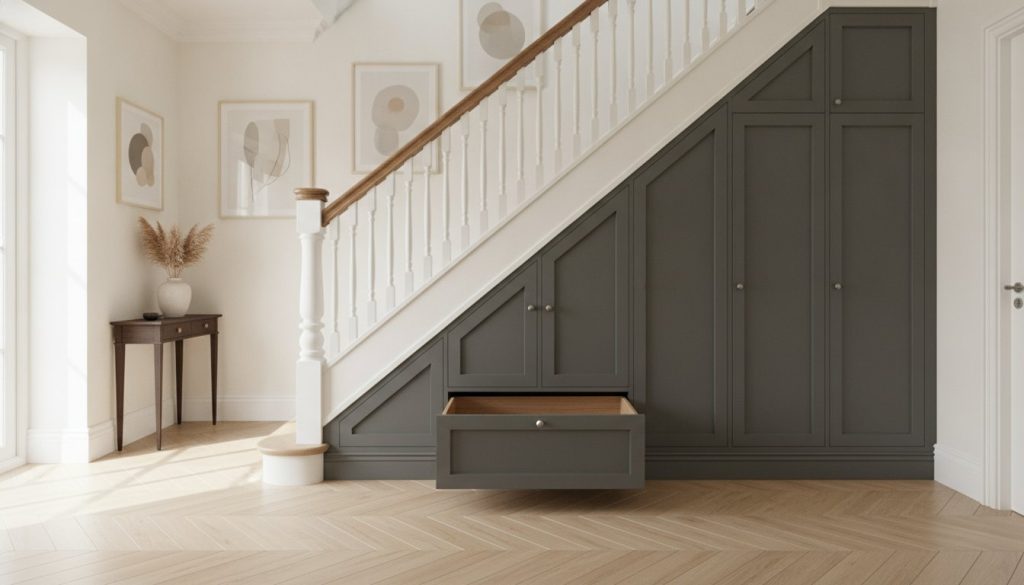
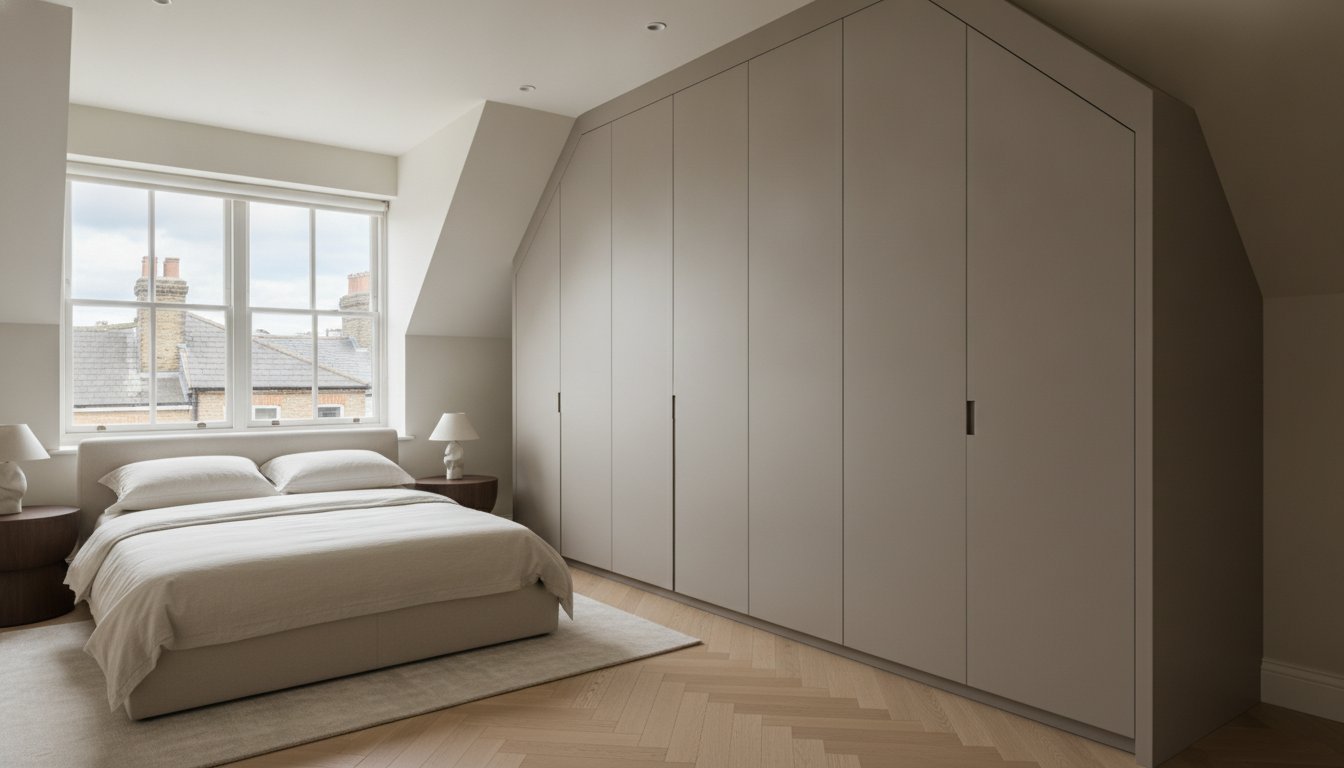
Architecture shouldn’t be an obstacle to organisation. In many UK homes, particularly period properties and modern loft conversions, the presence of eaves and pitched roofs creates a complex puzzle for storage. Standard, mass-produced furniture is designed for perfectly square rooms; it fails to account for the unique geometry of an attic space. This is where bespoke wardrobes for sloped ceilings become essential. Rather than forcing a rectangular box into a triangular void, these solutions are precision-cut to mirror the exact rake of the ceiling. This approach eliminates the “dead space” that typically accumulates dust and reduces the usable volume of a room.
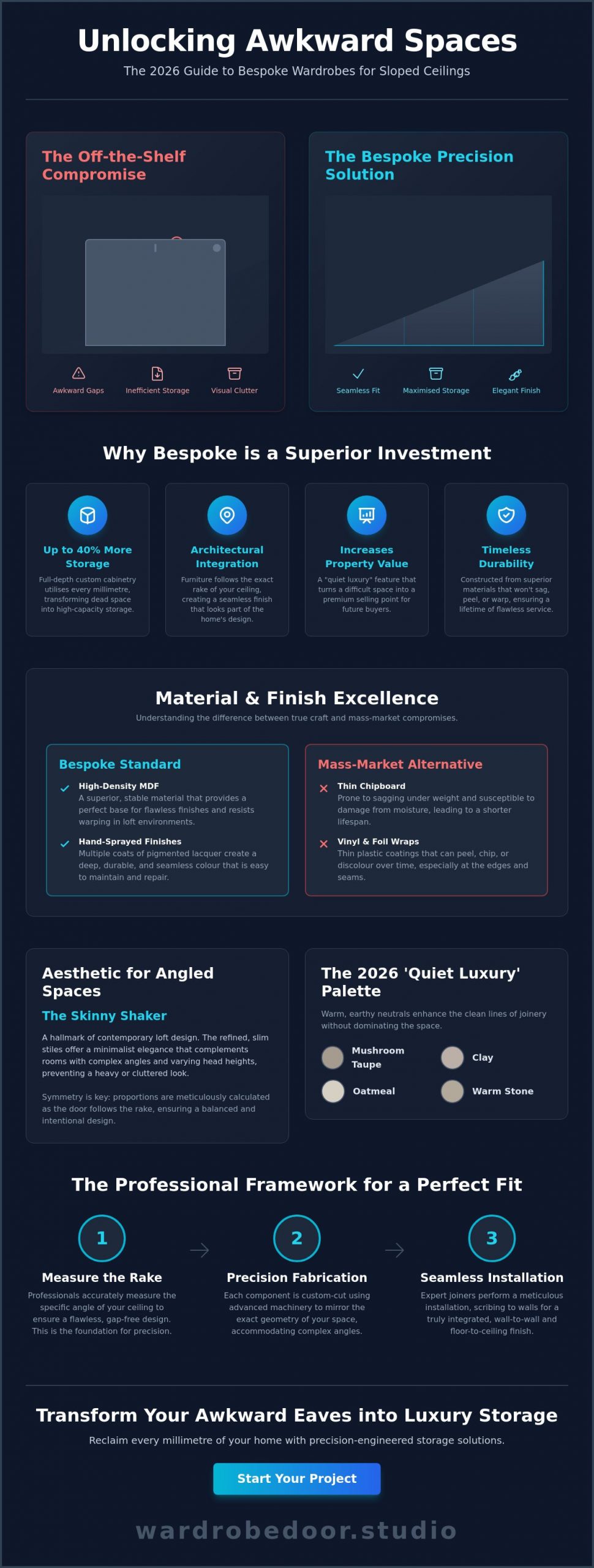
High-quality built-in cabinetry offers more than just a place to hang clothes. It serves as an architectural intervention that can fundamentally change how a room feels. Whilst some installers use a simple “scribe-to-wall” method to hide gaps, a truly bespoke approach involves constructing full-depth custom cabinetry. This ensures that every millimetre of depth is utilised, providing up to 40% more storage than standard freestanding alternatives. It’s a meticulous process that transforms a structural limitation into a sophisticated design feature.
Understanding the Challenge of Slanted Ceilings
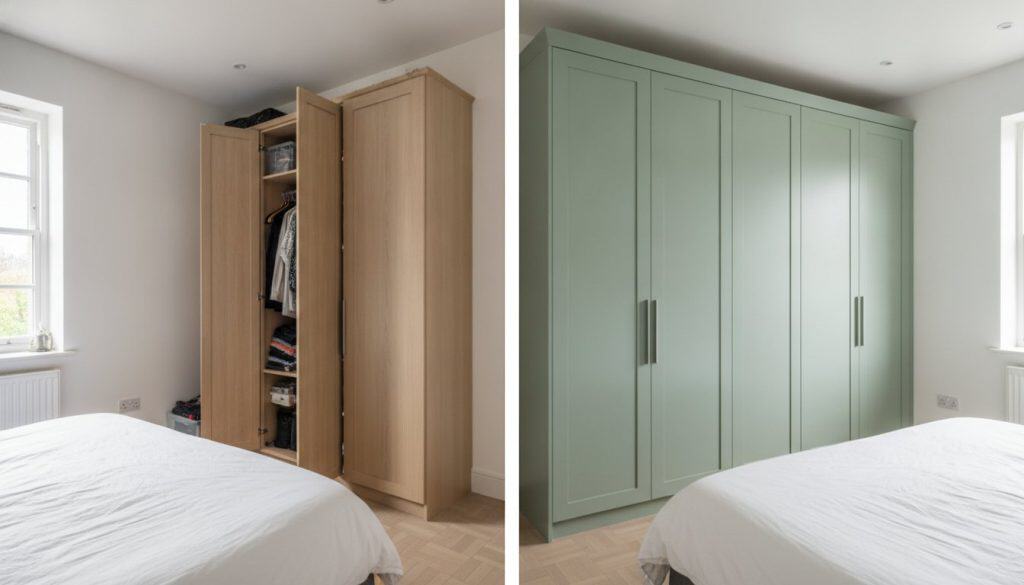
Sloped ceilings present a dual challenge: the loss of both vertical height and horizontal floor space. Off-the-shelf solutions, such as the IKEA PLATSA range, often leave awkward triangular gaps at the top or sides. These gaps aren’t just an eyesore; they’re a waste of valuable square footage. Precision joinery follows the “rake”, which is the specific angle of the slope, to create a flush, integrated appearance that looks like part of the original building. This seamless integration is particularly vital in smaller loft rooms where visual clutter can make the space feel cramped.
Bespoke vs. Modular: The Long-Term Investment
Choosing bespoke wardrobes for sloped ceilings is a strategic investment in property value. Unlike modular units made from thin chipboard, bespoke furniture utilises high-density MDF or sustainably sourced hardwoods. These materials don’t sag or peel over time. A floor-to-ceiling finish without unsightly filler panels creates a sense of “quiet luxury” that appeals to future buyers. It turns a difficult architectural feature into a premium selling point, ensuring the furniture lasts as long as the home itself. The result is a durable, elegant storage solution that respects the heritage and character of the property.
Choosing Your Aesthetic: From Skinny Shaker to Luxury Mirror Fretwork
Designing for an attic or loft conversion requires a sophisticated balance between technical necessity and visual elegance. Many homeowners assume that the steep angles of a pitched roof limit them to basic flat panels. However, precision-engineered bespoke wardrobes for sloped ceilings allow for the integration of intricate door profiles that would otherwise be impossible with off-the-shelf components. By adapting complex geometries to the rake of the ceiling, you can maintain a high-end aesthetic that feels intentional rather than compromised.
The Rise of the Skinny Shaker in Angled Designs
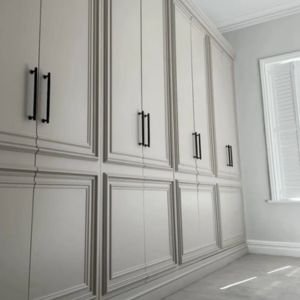
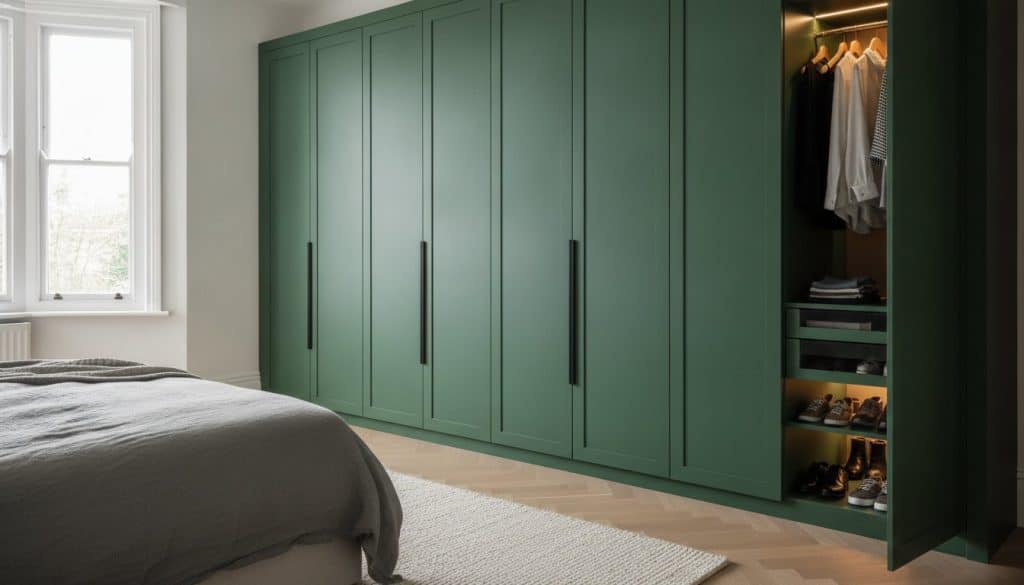
The skinny shaker wardrobe doors have become a hallmark of contemporary loft design. Their slim stiles provide a refined, minimalist alternative to traditional shaker profiles, which can sometimes feel too heavy in rooms with lower head height. When applying this style to a sloped ceiling, maintaining visual symmetry is paramount. As the door height decreases to follow the roofline, the proportions of the shaker frame must be meticulously calculated to ensure the internal panel remains balanced and aesthetically pleasing.
Earthy neutrals like clay, oatmeal, and warm stone are particularly effective for this style. These shades prevent the wardrobe from dominating the room whilst highlighting the clean lines of the joinery. To achieve the sharp, crisp edges required for these slim profiles, we utilise High-Density MDF. This material provides the structural stability needed for intricate, angled machining that won’t warp or degrade over time.
Mirror Fretwork: Elegance in Awkward Spaces
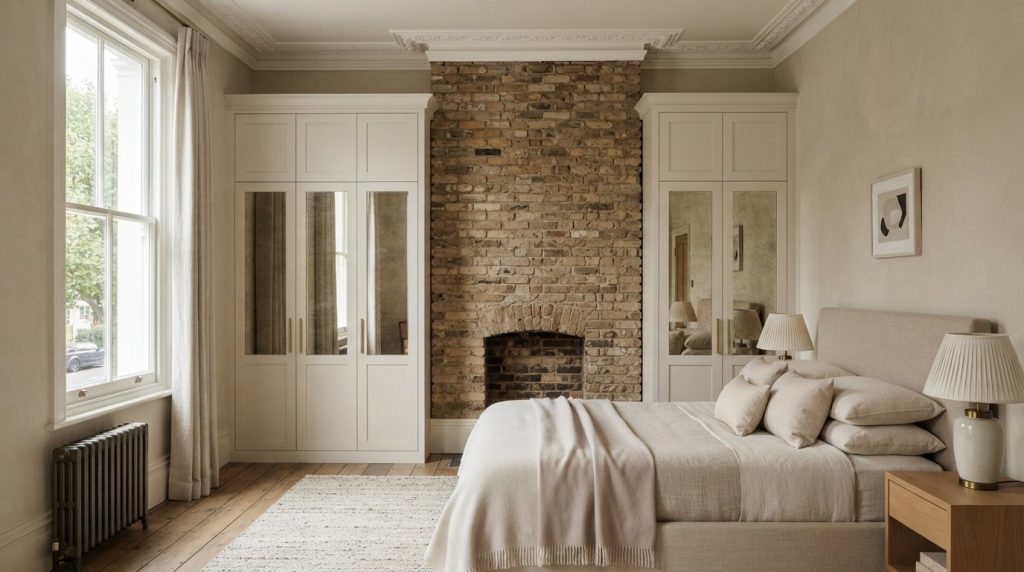
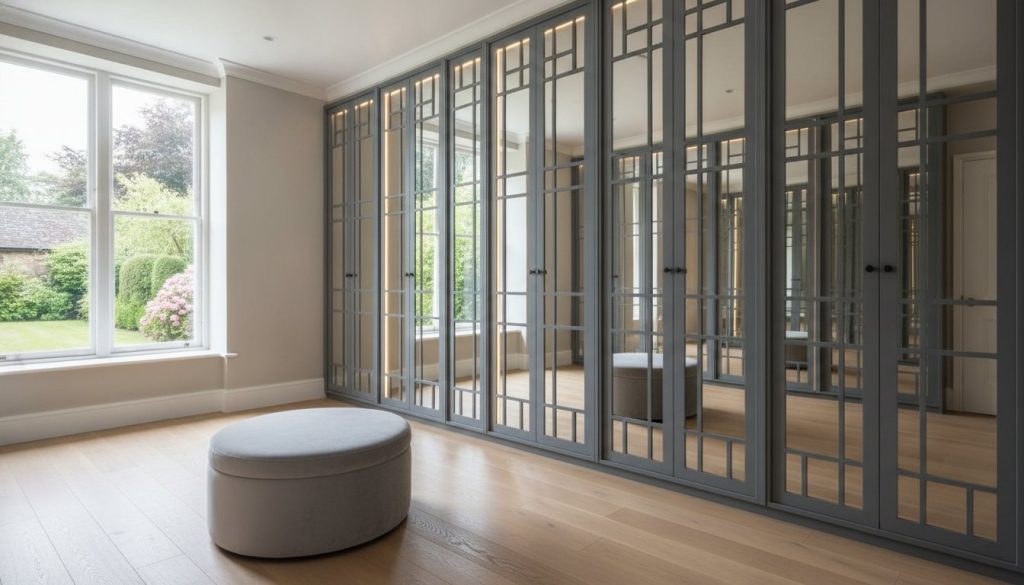
Loft rooms often suffer from limited natural light, especially in deep eaves. Utilising mirror fret wardrobe doors is a strategic way to mitigate this. The mirrored surface reflects light across the slope, creating an illusion of height and depth that makes the space feel far more expansive. It prevents a long row of fitted cabinetry from feeling “heavy” in a compact room.
Executing fretwork on a sloped edge requires extreme technical precision. The pattern must be adjusted so that it terminates elegantly against the angle, avoiding awkward cuts that disrupt the flow of the design. This level of detail ensures that your bespoke wardrobes for sloped ceilings act as a focal point rather than just a utility. It’s a hallmark of true luxury craftsmanship.
Ergonomics also play a vital role in these designs. Handle placement on angled doors should be lower than standard to ensure they remain accessible and comfortable to use. It’s often best to align handles with the lowest point of the rake to maintain a consistent horizontal line across the run. If you’re planning a loft renovation, you might wish to explore our collection of hand-sprayed door styles to find the perfect match for your architectural vision.
Material Excellence: Why High-Density MDF and Hand-Sprayed Finishes Outperform Mass-Market Alternatives
Loft conversions often feature high levels of insulation but can still experience significant temperature fluctuations throughout the year. This environmental factor makes the choice of material for your built-in furniture paramount. Selecting the correct substrate is the most critical decision in the construction of bespoke wardrobes for sloped ceilings, as the material must withstand the unique pressures of a rooftop environment without compromising on the aesthetic finish.
The Science of High-Density MDF
High-density moisture-resistant (MR) MDF is the industry standard for premium cabinetry, and for good reason. Unlike solid hardwoods, which naturally expand and contract with humidity, high-density fibreboard remains dimensionally stable. This stability is vital for the precise angled joints required in sloped designs. If the material shifts even a millimetre, it can disrupt the alignment of the doors and ruin the seamless look of the installation.
When browsing Dreamy Attic Room Designs, you’ll notice that the most successful projects prioritise smooth, unbroken surfaces. High-density MDF provides a perfectly flat, non-porous face that is ideal for contemporary painted styles. It doesn’t suffer from the grain telegraphing or knot-bleeding often seen in cheaper pine or standard-grade timber. This ensures your wardrobe retains its gallery-quality appearance for decades rather than years.
The Luxury of Hand-Sprayed Finishes
Mass-market alternatives often rely on vinyl or laminate wraps to achieve their colour. Whilst these look acceptable in a showroom, the heat and intense sunlight in a loft can cause these foils to peel or “delaminate,” particularly along the complex angled edges of a sloped door. A hand-sprayed finishing process is fundamentally different. It involves multiple layers of specialist primer and acid-catalyst lacquer, creating a hard-wearing surface that chemically bonds to the door.
The depth of colour achieved through spraying is incomparable to laminate. You have the choice between various sheen levels to suit your room’s light patterns:
- Satin Finishes: These offer a gentle glow that helps bounce light into darker eaves without creating harsh reflections.
- Matt Finishes: Ideal for a contemporary, “quiet luxury” look, matt surfaces absorb light and provide a velvety texture that feels sophisticated to the touch.
Choosing UK-based manufacturing for your bespoke wardrobes for sloped ceilings also provides a distinct durability advantage. Locally produced furniture doesn’t endure the stresses of long-distance shipping in humid containers. Instead, it’s crafted in a controlled environment and delivered directly to your home, ensuring the finish remains pristine. This methodical approach to production reflects a heritage of craftsmanship where quality takes precedence over speed, resulting in furniture that adds genuine, enduring value to your property.
Measuring and Specifying Your Slanted Wardrobe: A Professional Framework
Precision is the foundation of luxury joinery. When specifying bespoke wardrobes for sloped ceilings, the goal is to achieve a “zero-tolerance” fit where the furniture appears to emerge from the architecture itself. This requires a meticulous survey of the space, accounting for the structural idiosyncrasies common in loft conversions and period homes. In many British properties, floors are rarely level and walls are seldom plumb. Addressing these irregularities at the specification stage is what separates a professional installation from a standard modular attempt.
Step 1: Identifying the Sloped Dimensions
Start by establishing the vertical heights at both the lowest point, typically the eaves, and the highest point where the slope meets the ridge or flat ceiling. You must also measure the horizontal “run” of the slope to determine the rake accurately. To account for “wonky” walls, perform a three-point check: take these measurements at the back wall, the middle of the wardrobe depth, and the front line where the doors will sit. This ensures the angle remains consistent across the entire unit. If the floor isn’t perfectly level, always measure from the highest point of the floor to ensure doors don’t catch on carpets or floorboards after installation.
Step 2: Internal Configuration for Angled Units
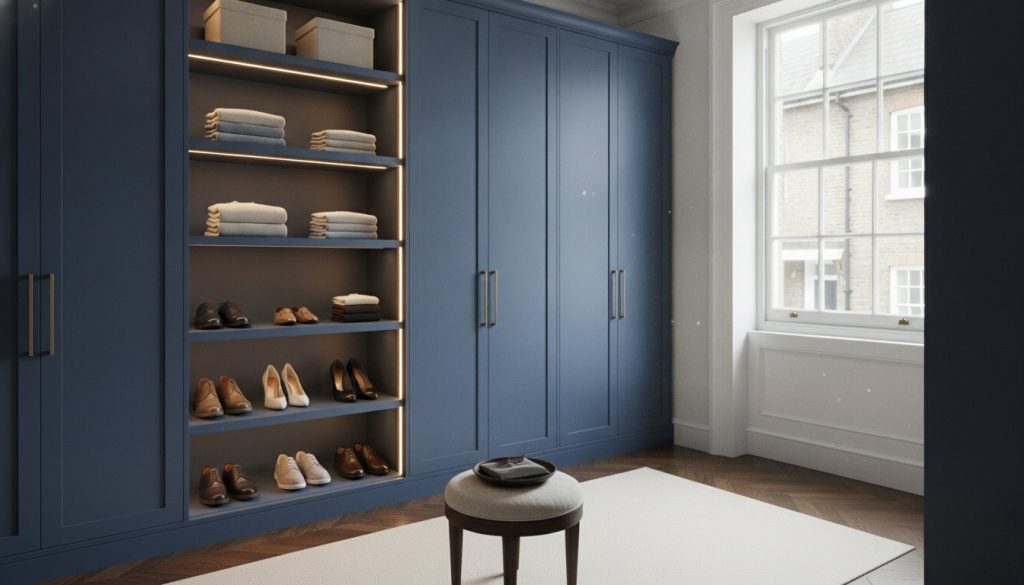
Interior layout must follow the logic of the slope to remain functional. Position full-height hanging rails in the tallest sections to accommodate coats and dresses. The shallower areas beneath the eaves are better suited for specialised storage. Utilising the lowest sections for pull-out shoe racks or deep drawers allows you to reclaim space that would otherwise be inaccessible. When planning the door layout, ensure that hinges are positioned on the vertical stiles rather than the angled top edge. This maintains structural integrity and prevents the doors from sagging over time. You should also allow for a small “scribe” or filler piece at the top to account for any slight bows in the ceiling plaster.
Professional results begin with professional planning and exact dimensions. If you’re a developer or a meticulous homeowner, you can order precision-cut bespoke wardrobe components to your exact specifications to ensure a flawless fit in any angled space.
Clearances are equally vital for a high-end feel. If you’re installing internal drawers near the top of a slope, ensure they have enough clearance to pull out fully without hitting the ceiling line. Similarly, hanging rails should be set at least 50mm below the ceiling to allow for the hook of the hanger. By considering these ergonomic details during the measurement phase, you ensure that the finished wardrobe is as effortless to use as it is beautiful to look at.
Navigating the Project: Professional Installation vs. Supply-Only Excellence
Deciding how to execute your vision is the final step in the journey toward reclaimed space. Whilst the technical demands of bespoke wardrobes for sloped ceilings are significant, the process is streamlined through two distinct pathways: a comprehensive, managed installation or a precision-led supply-only service. Both options leverage the same high-standard British manufacturing, ensuring that the final result remains a durable, high-value addition to your property. The choice ultimately depends on your project’s scale and your access to on-site expertise.
The Full Design and Installation Service
A fully managed bespoke fitted wardrobes project offers the highest level of assurance for homeowners. This pathway begins with a professional site survey where every angle is laser-measured to create a detailed technical drawing. This stage is crucial because it translates your aesthetic preferences into a workable engineering blueprint. Expert fitters then take over the on-site execution, using specialised scribing techniques to ensure the cabinetry sits perfectly flush against uneven plasterwork. This end-to-end service typically follows a 7 to 12-day turnaround from final design approval to completion, providing a seamless transition from an awkward attic void to a sophisticated dressing room.
Supply Only: Solutions for Trade and DIY
For contractors, developers, or highly skilled homeowners, the supply-only model provides maximum flexibility without compromising on quality. Utilising trade supplier wardrobe doors and custom-sized carcasses allows professionals to incorporate luxury finishes into their own project timelines. This approach is particularly effective for large-scale developments where consistent quality across multiple rooms is required. It empowers trade professionals to offer high-end joinery without the overhead of their own manufacturing facility.
Every component is manufactured in our regional facility and benefits from nationwide delivery, arriving ready for on-site assembly. This democratises access to precision-engineered furniture, allowing trade professionals to deliver a millimetre-perfect finish using our technical specifications. By ordering custom-sized components, you eliminate the risk of on-site errors that often occur when trying to modify standard-sized doors to fit a ceiling pitch.
Moving from a design concept to a technical order requires a clear understanding of your room’s unique rake and height. Whether you choose a full installation or a supply-only package, the focus remains on the enduring value of the product. By choosing bespoke wardrobes for sloped ceilings that are designed and manufactured in the UK, you support a tradition of excellence whilst ensuring your furniture is built to last. The transition to a more organised, elegant home begins with a single, well-considered specification that respects the architecture of your space.
Elevate Your Interior with Precision Craftsmanship
Reclaiming the unused potential of your loft or eaves room requires more than just standard storage; it demands a fusion of technical engineering and artistic vision. By selecting bespoke wardrobes for sloped ceilings, you ensure that every millimetre of your floorplan is utilised whilst enhancing the architectural character of your home. Whether you opt for the minimalist lines of a Skinny Shaker or the reflective elegance of Mirror Fretwork, the result is a seamless, integrated finish that mass-market alternatives simply cannot replicate.
Our specialists in complex sloped and angled designs provide a service rooted in heritage and modern precision. Every component is hand-sprayed in England to achieve a gallery-quality surface that stands the test of time. With nationwide delivery across the UK, we bring the standards of high-end joinery directly to your project, whether you require professional installation or a supply-only solution for your own contractors.
Explore our range of bespoke wardrobe solutions and request a consultation to begin your transformation. Your home deserves furniture that respects its unique geometry and reflects a commitment to enduring quality.
Frequently Asked Questions
Can you put a wardrobe against a sloped ceiling?
Yes, you can certainly install cabinetry against a pitch. Precision joinery allows for bespoke wardrobes for sloped ceilings to be engineered to follow the exact rake of your architecture. Unlike standard units that leave wasted voids, these solutions are built into the eaves to maximise every millimetre of storage whilst creating a seamless, integrated look.
How much do bespoke wardrobes for sloped ceilings cost?
The investment for a custom-fitted solution depends on several variables, including the total linear meterage, the complexity of the internal configuration, and the chosen door style. Whilst industry reports for 2026 suggest that loft-fitted wardrobes often range between £2,000 and £6,000, the final cost reflects the level of craftsmanship and the premium materials utilised. Every project is unique; therefore, a detailed consultation is required to provide an accurate specification.
What is the best door style for a loft conversion wardrobe?
Skinny Shaker and Flat Panel doors are the most effective styles for attic spaces. Their slim profiles and clean lines prevent the furniture from dominating a room with limited head height. For those seeking to brighten darker eaves, Mirror Fretwork is an excellent choice. It combines traditional fretwork patterns with reflective surfaces to create an illusion of depth and light.
Can I replace the doors on my existing sloped wardrobe?
You can replace doors on an existing carcass if the internal structure remains stable and level. We provide custom-cut doors designed to match the specific angle of your existing slope. This is a cost-effective way to upgrade to a hand-sprayed, luxury finish without the disruption of a full room renovation. It’s an ideal solution for refreshing a dated loft conversion.
How do you measure the angle of a sloped ceiling for a wardrobe?
To measure the angle accurately, you must establish the vertical height at the lowest and highest points of the slope. You then measure the horizontal distance between these two points to calculate the rake. It’s vital to perform this check at the front, middle, and back of the wardrobe’s intended depth. This process accounts for any “wonky” walls common in older British properties.
Is MDF or solid wood better for angled wardrobe doors?
High-density, moisture-resistant MDF is the superior choice for angled doors. Unlike solid timber, which is prone to expansion and contraction in the variable temperatures of a loft, high-density MDF remains dimensionally stable. This stability ensures that the precise angled cuts remain sharp and the doors stay perfectly aligned over time without warping or cracking.
Can sloped wardrobes include mirrors?
Yes, mirrored surfaces are highly recommended for bespoke wardrobes for sloped ceilings. Mirror Fret Wardrobe Doors can be precision-machined to follow a slanted roofline whilst maintaining the integrity of the fretwork pattern. This design choice is particularly effective in low-ceilinged rooms where it helps bounce natural light from dormer windows across the entire space.
Do you offer supply-only bespoke doors for slanted eaves?
We provide a comprehensive supply-only service for trade professionals, developers, and skilled DIY enthusiasts. This service includes precision-manufactured doors and carcasses cut to your exact technical specifications. All components are hand-sprayed in our UK facility and delivered nationwide, ensuring that luxury craftsmanship is accessible for projects managed by your own on-site team.